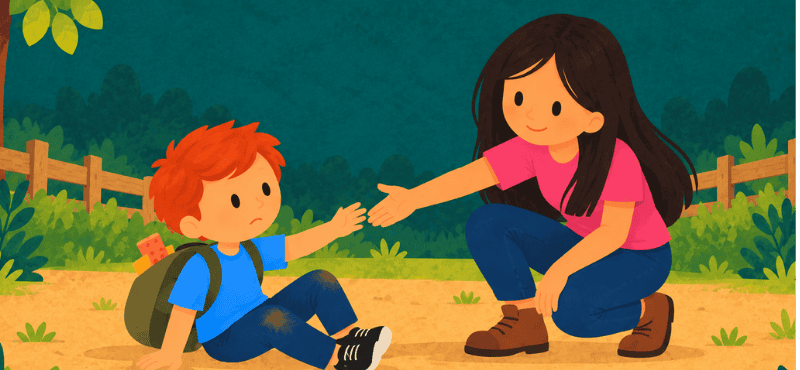
Every child carries an invisible emotional backpack. And every day, we all play a part in which bricks go into it.
Some bricks are small. Some are heavy. Some disappear quickly, while others stay for a long time. And sometimes, the smallest brick can be the one that makes everything topple.
Brick Theory gives children and the adults around them a simple, shared way to understand what’s happening beneath the surface.
For Children
A way to explain how they feel, without needing to find the words.
Children don’t always know why they’re upset, overwhelmed or struggling. They may not yet have the words to describe their emotions.
Brick Theory gives them a simple way to communicate how they’re feeling. Instead of having to explain everything, a child can say, “My backpack feels heavy today.”
It’s a starting point for understanding their emotions, recognising their bricks and learning what helps make their backpack easier to carry.
For Adults
Looking beyond behaviour to understand what’s underneath.
Adults don’t always see the worries, pressures or experiences a child is carrying. Sometimes, without realising it, we add another brick to their backpack.
Brick Theory encourages parents, teachers and carers to look beyond behaviour and consider what might be happening underneath. A small request or unexpected change could be the final brick in an already heavy backpack.
It’s a starting point for recognising the impact of our actions and finding ways to help lighten their load.
Interested in Learning More?
Book Training
We deliver seminars nationwide, helping teachers, parents and professionals understand Brick Theory and put it into practice to support children’s emotional wellbeing and support inclusion.
Bring Brick Theory into your classroom with simple, practical resources that help children understand emotions and build a shared language. Including the Brick Theory story, song and backpack tracker
Join one of our online training sessions to discover how Brick Theory works and how you can use it to support children’s emotional wellbeing. Enquire about our next available session.